
It is often said that one of the distinguishing factors between humans and other animals is our capacity for learning quickly from our mistakes and spreading the learned lessons through culture to posterity. Such capacity has immensely benefited our species and helped elevate the average-sized homo sapiens to the top of the power hierarchy. But despite this fact, if there were a prize for obtuse stubbornness in retrying mistakes, we would collect all the accolades to the astonishment of all other animals (were they able to appreciate accolades). Although the examples of this stubbornness are numerous and spread over the span of history, one pertaining to our modern society is taken the shape of a “war,” or at least it is declared to be one by those who religiously adhere to it. It is a never-ending war, one that America and every other nation that has ever waged has continuously lost. It is the “War on Drugs.”
It is a catchy title, no doubt, and one that perfectly suits the country’s creativity in naming its challenges (e.g., The War on Poverty, the War on Terrorism. Declaring war on inanimate objects and abstract concepts is ostensibly used to instill morale into society’s sense of urgency). Although he did not coin the term, President Nixon certainly popularized the war on drugs after calling drug use “public enemy number one.” He also established the Drug Enforcement Administration (DEA), the agency responsible for enforcing controlled substances laws and regulations. President Reagan wished to run up “a battle flag” to crackdown on drug use. Reagan also signed the Anti-Drug Abuse Act in 1986 that imposed harsh mandatory minimum sentences for drug offenses. President Bill Clinton signed the Violent Crime Control and Law Enforcement Act of 1994 that put into place the three-strike rule whereby life imprisonment was mandated for anyone convicted of a third violent or drug offense. President George H. Bush continued his predecessors’ hard lines to the extent that he orchestrated a drug deal across the street from the White House so that he could hold up a bag of crack cocaine just to give more aura to his speech.1 (One might suspect that by this point, presidents’ speeches on drugs had become so boring as to require a stunt to attract a few extra eyeballs). Despite the lip service readily given by the three presidents since 2008 to loosen the grip on controlling drug offenses, controlled substances have remained “controlled” by our federal government though some progress has been made on the state level.
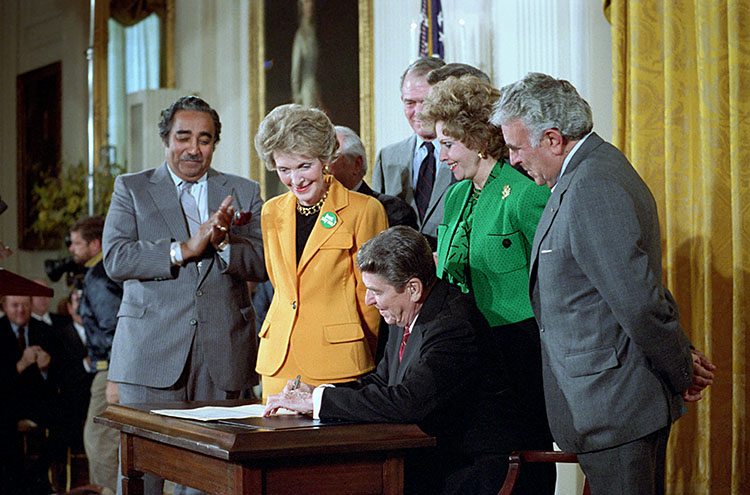
President Reagan with Nancy Reagan during the signing ceremony for H.R. 5484 the Anti-Drug Abuse Act of 1986
Let us put the efforts undertaken above into numbers. The Anti-Drug Abuse Act allocated $1.7 billion to combat illegal drug activity.2 FBI’s drug enforcement units during Reagan’s administration saw a ten-fold boost in their annual budget from eight to $95 million in his first four years.3 All presidents after Reagan continued to increase the budget for drug enforcement with Clinton providing over $8 billion in funds to state and local prison systems for punitive responses to infractions in drug laws (and violent crimes).4 From 1972 to 2021, the DEA’s budget has increased by a whopping 50-fold from $65 million to $3.28 billion.5 Estimates vary, but the total amount of money spent on this “war” has, by conservative estimates, amounted to over $100 billion.6 This figure only represents the actual funds granted to various governmental agencies to combat drugs. Add to this figure the cost of criminal procedures, imprisonment and/or probation for drug offenders paid for by the government and the amount skyrockets.7 As citizens of the nation that has decided to allocate vast resources to this “war,” we certainly should ponder upon the following questions:
- Has drug use declined over the years that we have waged an all-out offensive against its use?
- What is the obsession of our politicians and a great section of our society with controlling substance use?
There may be other questions worthy of being asked but I believe the crux of the issue lies in these. Let’s answer them.
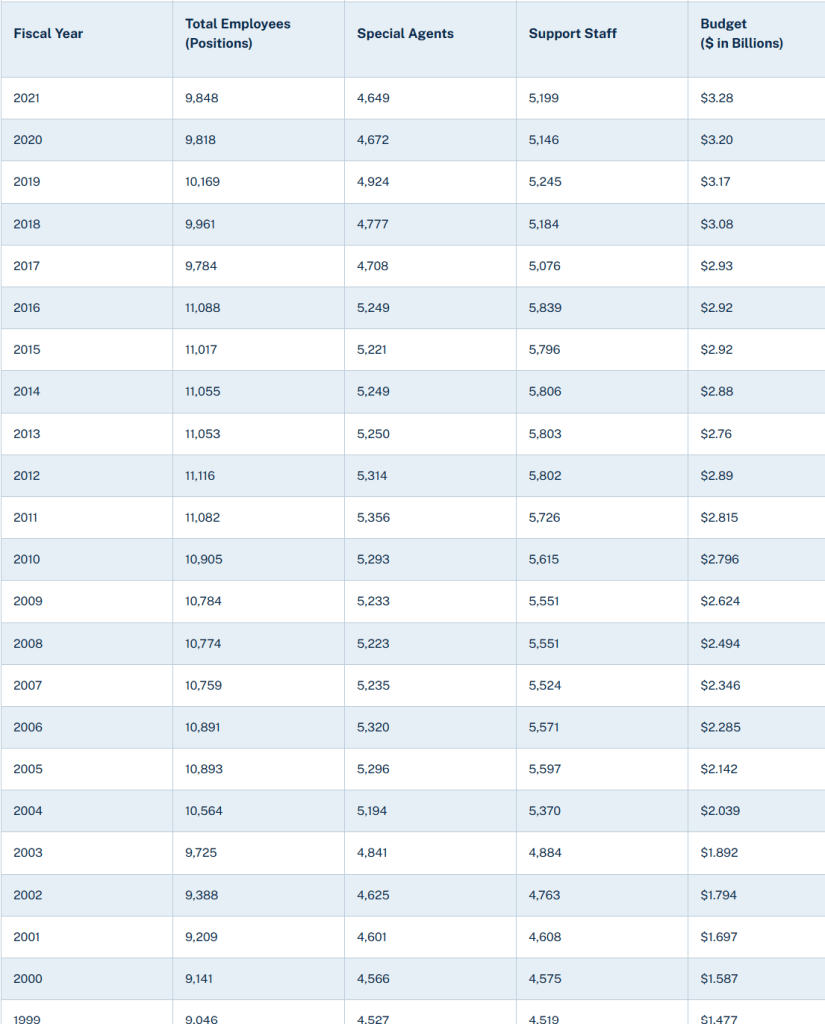
DEA Budget by the Year
Source: Drug Enforcement Agency
The answer to the first question is a resounding “NO.” Drug use disorder death rate has dramatically increased from 1990 to 2019 from 2.06 to 18.83 deaths per 100,000.8 In the same span of time, perhaps not surprisingly, the share of the U.S. population with drug use disorder also saw a hike from 2.1% to 3.4%.9 Accounted for population growth in the intervening years, this translates to 6 million more people struggling with drug use. Deaths attributed mainly or solely to drug use disorder rose from over 30,000 in 1990 to over 170,000 2019.10 Prohibition on drug use appears to have had no noticeable effect on lowering either drug use disorder or deaths attributed to it in comparison to alcohol which is a legal substance. In fact, if there is an effect, it could be that tough-on-drugs policies have contributed to the drug use disorder in the country. However, this is a claim that requires statistical analysis (and in particular regression analysis) which is beyond the scope of this blog post. Suffice it to say that the War on Drugs has been unable to contain the drug problem. (There is one sense in which you could still claim that drug policies have been effective in curbing the drug numbers. The argument for this should suppose that drug use disorder and deaths would have increased even more had there been no government response. This is not only very difficult to substantiate but also dubious given the data that we will shortly examine.)

Share of the U.S. Population with Drug Use Disorder
Source: Institute For Health Metrics and Evaluation
Portugal decriminalized all drugs in 2001. At the time, drug use disorder death rate stood at 0.63 per 100,000 people.11 In 2019, it fell to 0.38 deaths per 100,000.12 The share of the population with drug use disorder has barely budged in the same time period.13 Deaths attributed mainly or solely to drug use disorder also decreased in these 18 years, though the numbers were low to begin with.14 Portugal is a case in point but, unfortunately, there are not many examples of such country. There are, however, other countries that have taken a softer approach to personal drug use. Among them is Switzerland which took on rather an unorthodox path to solve their drug problem. Their four-pillar policy – prevention, treatment, harm reduction, law enforcement – has now been widely recognized as a successful model.15 While many drugs remain illegal in the country, Switzerland’s emphasis on treating drug use as a health crisis rather than a criminal activity has provided them with better results than whatever it is we are doing on this side of the planet. Drug use disorder deaths (5.16 to 2.16 per 100,000), share of the population with drug use disorder (1.7% to 1.4%), and deaths attributed mainly or solely to drug use (394 to 212) have fallen since 1994 when Switzerland had a change in its drug policies.16 None of the above is necessary for me to make my point. As it will become clear, I view drugs as a personal matter and government interference in it as a violation of individual privacy. But perhaps it was worth mentioning the data to bring onboard those who view laws and regulations as a way to control drug use.

Portugal Drug User Death Rate
Source: Institute For Health Metrics and Evaluation

Switzerland Drug User Disorder Death Rate
Source: For Health Metrics and Evaluation
Onto the second question, there is an uncanny stance that many take on the drug problem. Many would support harsh rules regulating substance use but only when it applies to others, not their own family members. I have scarcely met anyone who wishes that one of their loved ones struggling with drug use be put in jail and punished with heavy fines. Instead, they want treatments and rehabilitation. But you may take the following position. Drug users are not the problem, it is the drug distributors who are deserving of punishment. This may sound wise but under further inspection, it is quite a paradoxical and strange position. That the drug distributors exist in the first place is a testament to the fact that there is demand for drugs and absent a complete annihilation of all drugs and their manufacturing, this demand will persist. Another argument is to suggest that government regulations and criminalization of drugs, while not eradicating the issue or even mitigating it, is necessary since one of the functions of the government is the promotion of health and safety of society. But this argument fails in that it singles out certain drugs. If indeed the goal of the government is the promotion of people’s health, why are sugary drinks legal and even sold to kids at a low price? Why are fast food chains not raided like drug deal rendezvous? Why isn’t physical activity mandatory for all people? Why are high-calorie and highly processed foods not banned in all supermarkets across the country? And for that matter, why are cigarettes and cigars in the market? Where is the crackdown on alcohol consumption? If you believe any of the above is perhaps hyperbole and overstatement, consider the following facts: 1 in 5 children and 2 in 5 adults suffer from obesity.17 This incredibly high rate costs the U.S healthcare system an average of $173 billion each year18 which amounts to roughly %2.5 of the U.S. annual budget.19 It is no surprise that high-calorie, highly-processed foods, and sugary drinks contribute a great deal to the nation’s obesity epidemic. Smoking is the leading cause of cancer, and it costs $300 billion a year in healthcare costs.20 Alcohol provides very little to no health benefits when consumed in moderation and is almost always harmful when heavily consumed.21 On the other hand, the health benefits of physical activity are no secret to anyone. Physical activity has a sizable impact on reducing all-cause mortality, specifically reducing chances of cardiovascular diseases, diabetes, many types of cancer, and hypertension.22 So, back to our questions above, why don’t we task our government with taking the necessary actions on these matters? This double-standard on drugs seems quite unwarranted.
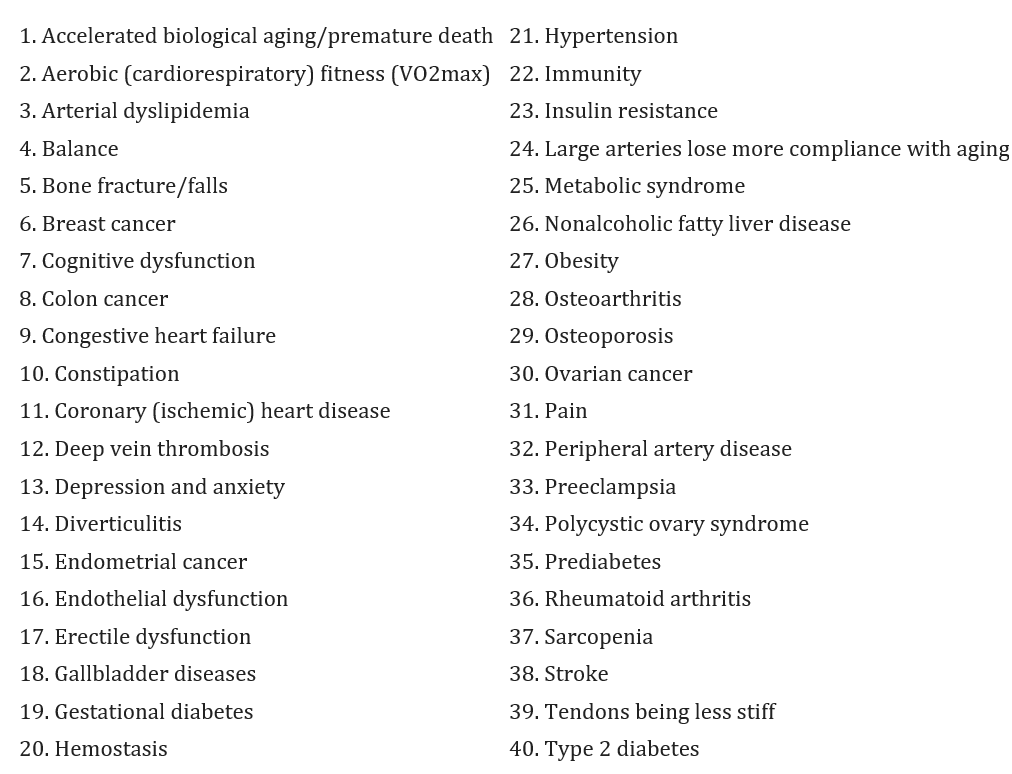
List of Conditions Worsened by Lack of Physical Activity
Source: National Center for Biotechnology Information23
The government’s role in public health safety is undoubtedly vital. (Afterall, this is one of the main reasons we pay taxes). But there must be a fine line between safety and personal freedom. While contagious diseases require top-down management and administration, chronic or non-contagious diseases or conditions such as addiction do not necessarily need government regulations. To defend the previous sentence, I must mention what I consider to be one of the government’s functions which is to protect, in any interaction, the well-being and rights of only those who are inadvertently or intentionally affected by someone else’s decisions and actions while the affected person did not provide informed consent to the said decisions and/or actions. (Some exceptions are made in the case of children, but I am mostly concerned with adults in this case). If any harm is befallen on the affected person, then the government should require compensation by the responsible parties. If this function of the government is something you disagree with, then you would be hard-pressed to define what the government should do at all. But if you believe that my description above is inadequate, then any modification to it must be accompanied by sound reasoning. I, for one, cannot fathom what sort of rationale could grant the government the authority to regulate consenting adults’ decisions while all those affected are the ones involved in the consensual interaction in the first place. (You might argue that addiction does affect those close to the addict but so does diabetes and cancer. Such a line of reasoning stretches too far.) Here is why I believe government regulation is unlikely to lower drug use or drug related deaths (or “control crimes” or whatever it is that our politicians are always one election away from solving). The problem lies in the interests of the government. Because it is mainly concerned with security as opposed to health promotion, if drug dealers and users can be rounded up and jailed, the government can rest assured that it was a job well-done since it won’t have to answer for its failed tactics and false promises. Afterall, it is the responsibility of the people not to commit crimes and the government to punish and deter them. Once we hand over the responsibility of personal safety and health back into the hands of the individual, we can have a more sober conversation about how we can best help those most negatively impacted by drugs.
So, should all drugs be decriminalized? Here is my answer; those drugs the consumption of which do not result in contagious diseases should be decriminalized. This is consistent with my earlier words about the government’s role in taking interest in people’s well-being and rights. All subsequent questions concerning treatment of drug addiction, handling of drug epidemics where they do occur, classifying drugs based on their potential danger, and many more should be discussed in an open and scientific way free of governmental threats. There are many individuals who are shackled by our justice system for drug offenses who would otherwise have been productive members of society (and even if not productive, then at least free members of society since freedom itself has value). Billions of dollars would also be saved which is currently being spent both on enforcing drugs laws and prosecuting drug users and dealers. If you are a fan of lower taxes and less government spending like me, then it means more money for individuals that would no longer be allocated to these wasteful efforts. If you view a larger role for the government, then this money could be rerouted to more worthy causes, perhaps treating addiction or investing more in healthcare. There is more to be said on this topic, but one thing is clear, the U.S. “tough-on-drugs” policies have only burned our human and financial capital at best and resulted in devastation at worst. As much as it is hard for Americans (and non-American too to be fair), we must admit that drugs have defeated us in this war and no last battle, no heroic charge, no temporary retreat and regrouping for another offensive, and no “military” tactic will save the day. Let’s look the truth in the eyes and say calmly “we cannot win this war and we are willing to negotiate.”
- washingtonpost.com: Drug Buy Set Up For Bush Speech ↩︎
- Jesse Ventura. American Conspiracies (New York: Skyshore Publishing, 2010), 117. ↩︎
- Beckett, Katherine (1997). Making Crime Pay: Law and Order in Contemporary American Politics (1999 Revised ed.). London: Oxford University Press. pp. 52–53, 167. ISBN 0195136268. ↩︎
- Bill Clinton and the 1994 Crime Bill – FactCheck.org ↩︎
- Staffing and Budget (dea.gov) ↩︎
- See no. 2, 3, 4, and 5. Also see Ending the War on Drugs: By the Numbers – Center for American Progress ↩︎
- Ending the War on Drugs: By the Numbers – Center for American Progress ↩︎
- Opioids, Cocaine, Cannabis, and Other Illicit Drugs – Our World in Data ↩︎
- See no. 8 ↩︎
- See no. 8 ↩︎
- See no. 8 ↩︎
- See no. 8 ↩︎
- See no. 8 ↩︎
- See no. 8 ↩︎
- For more information see Inside Switzerland’s Radical Drug Policy Innovation (ssir.org) ↩︎
- See no. 8 ↩︎
- About Obesity | Obesity | CDC ↩︎
- See no. 17 ↩︎
- Federal Spending | U.S. Treasury Fiscal Data ↩︎
- Health Topics – Tobacco – POLARIS (cdc.gov) ↩︎
- Alcohol use: Weighing risks and benefits – Mayo Clinic ↩︎
- Health Benefits of Exercise – PMC (nih.gov) ↩︎
- Table – PMC (nih.gov) ↩︎
 Drunk On Reason
Leave a comment