From the moment the results of the 2024 U.S. general election started trickling into news outlets and a sight of possible defeat for Democrats seemed an immediate reality, a stream of unending questions began to be posed regarding the reasons for that defeat like the sound of a train coming from afar,closing in, and reaching its zenith in the following weeks after the election. There is no shortage of answers given to the various questions asked in many different forms which, to me, all boil down to this fundamental question; what is wrong with Democrats? It is often suggested by many on the Left of the political aisle that Donald Trump is the most unfit candidate to have ever run for President, and if not ever, then at least in living memory. Despite this, Democrats ran three elections against him and lost two, a pretty sad record. Are the American people so naive and gullible as to vote against their own interests for the biggest “fraud” and “grifter” in American politics? And if the answer to the previous questions is yes, then did the very same people have an awakening and become wise just four years ago? The stream of responses to such questions, unlike the responses to the question of “what is wrong with Democrats,” do not seem to be in large supply. What I’m hoping to achieve through this post is to provide an alternative view of this election, one that does not attempt to dramatize nor trivialize the result of it.
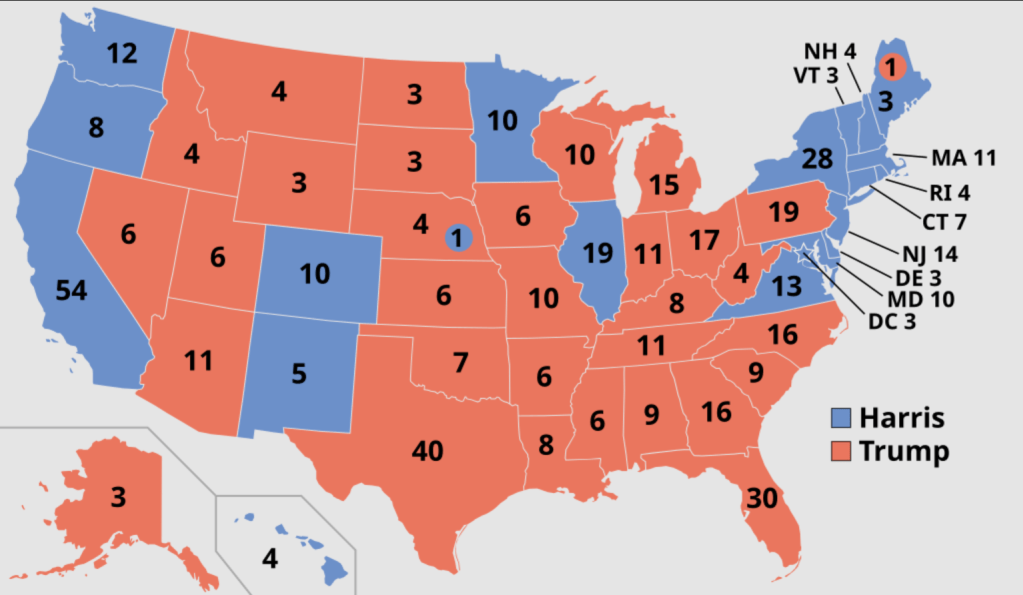
Firstly, there was nothing significant about the result of this election. It was not the largest Electoral College or popular vote win in U.S. history or even the past few elections. The House of Representatives ended up being split 220 to 215 to the GOP and Republicans managed to gain a total of 4 Senate seats. There were barely any surprises in Gubernatorial or state elections. In fact, everything about this election cycle was run-of-the-mill U.S. politics; an assortment of close elections in tight races and comfortable wins for both parties in their safe havens. That Trump swept all the swing states is nothing to lose sleep over trying to figure out why because a candidate being one point up in one swing state is likely to be doing one point or so better in all other states on average. If a future citizen looks back at the 2024 election cycle and examines the makeup of the executive and the legislative branches of the government, he would find nothing noteworthy to be captured by. Surely the election was of immense significance to many of us who live through this period of time, but on a grand scale of things, the past eight years and the following four years (short of a major catastrophe) will perhaps be a footnote in all future history books at best. (Aside from Covid of course, but I’m not even sure how big of a story it will be years from now).
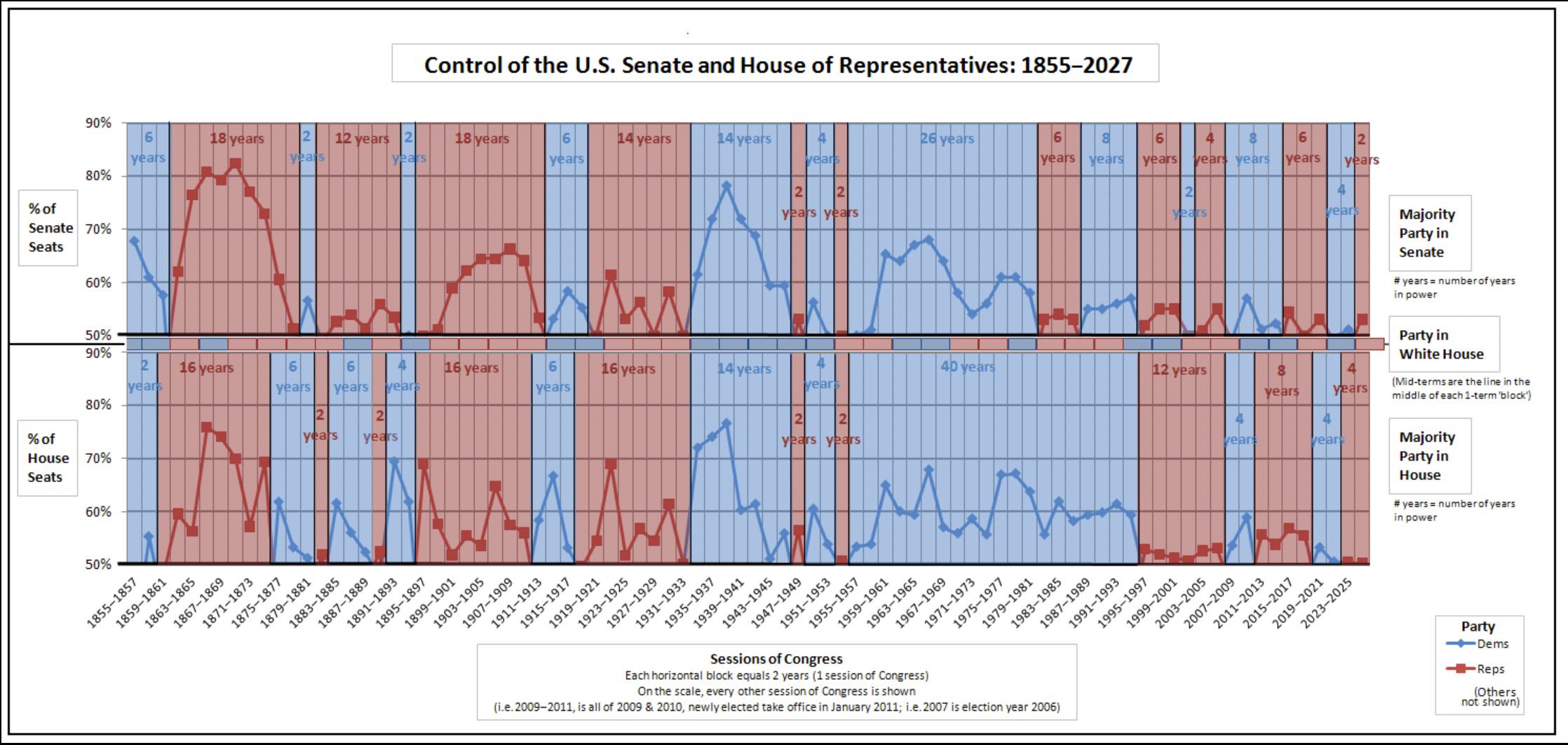
In fact, the torrent of questions from Democrats and Progressives who attempt to diagnose the disease and find the cure is no different than the one posed by the GOP only four years ago and again two years after that in the aftermath of a disappointing midterm election for the Republicans. The truth is that the GOP platform hasn’t changed much since 2020 and certainly not at all since 2022 but the result of this election cycle was, if judged only by the eventual losers and winners of the levers of power, a total reversal of the public opinion. However, this reversal seems to have also been in order only four years ago when Democrats had a fine week in November 2020 after a dismal 2016. In fact, save one or two exceptions in extraordinary times, I challenge the reader to pick any period of time at random in the history of U.S. politics ever since the Civil War and find a consistent voting pattern over a decade by the citizens of this vast nation. What is perhaps surprising is the perpetual efforts by the losing side to attempt to find a “solution” for its future and labeling the particular election as “the waking up call” for the party. This wake-up call is often accompanied by shifting the blame on some faction of the party who is always, no doubt, not a part of that faction. In the current cycle, the Progressives have put the blame on the Democratic establishment for “abandoning the working class” as Bernie Sanders and many others have succinctly put it and the more moderate Democrats are ceaselessly attacking the far Left for its “radical” ideas regarding social and class conflicts.
There has been some change of policy and tactics from the Tech giants too. Meta, for example, alongside other corporations, ended its DEI program and is replacing its fact-checking team. To shed light on these decisions, Mark Zuckerberg said in a recent Podcast that the result of this election showed a change of culture among the American people. Similar tone has been used to make the same point; that America is changing, or has changed, with respect to certain cultural issues. Even before the election, many Democratic candidates distanced themselves from the mainstream or Left-leaning Progressive viewpoints. Many of them, especially in the South, voiced concerns about the illegal immigration at the Southern border and proposed tougher measures to limit the flow of people into the country. Some other candidates openly opposed the participation of biologically male athletes in women’s sports, a point of contention and ambiguity that has plagued the Democratic party at least in the last eight years. Still others, in more comfortably Blue districts, doubled down on more interventionist economic policies to help alleviate the effects of high inflation at the beginning of Biden’s term. It is ironic that the 2022 midterm election, when the inflation was higher and the economy in a less than solid shape, was by all measures, a win for Democrats but when the economy had fully recovered by 2024, it was the GOP that had a field day on election night.
One can speculate on these and other issues as the “reason” for a Democratic defeat and I would like to provide my point of view here. Firstly, as I mentioned already, I believe the result of this election cycle was nothing to be surprised about or even scratch our heads over. This was not a revolution nor a major defeat or win for either party. It was close just like most other U.S. elections. However, I owe the reader my thoughts on what factors influenced the election to play out the way it did, to the extent that such factors can be identified. To begin, it is important that Liberals not lose sight of the fact that it is not always your actions that solely determine the result of the election. It is sometimes what your opponent does too. For so long, and consistent with human nature, both parties have focused entirely on their own affairs, interpreting election results as either a rejection or approval of their stance on issues. This is certainly a narrow-minded view and one that does not capture the entire picture. Voters, in many instances, pay attention to both sides. It is not just how you would handle issue X, it is how your opponent would propose to handle it as well that voters listen to. So, to purely blame one another within the party without putting a just emphasis on perhaps some better policy proposals by the GOP is not only myopic but also arrogant. If Bernie Sanders thinks that voters chose Republicans because the Democrats have abandoned the working-class, he ought to answer a more difficult question; why would the voters pick a party that, in the eyes of Progressives like himself, so blatantly disregards the working-class over a party that may not fully live up to its commitments to the people? Is it not the case that almost every policy Sanders and others like him propose are much more likely to be supported and to have been implemented by Democratic politicians- from higher minimum wages to stronger labor unions, from expanding medicare and medicaid and other welfare programs to taking a more lenient approach towards convicts? Are Progressives suggesting that their party must do everything perfectly or else the people will choose the option that does not care about them at all? Such ridiculous analyses do not provide much insight for anyone caring to understand the whys and the hows. So, the first step is to realize that sometimes your opponent is good and has good policies, whether this makes anyone uncomfortable or not.
But speculation isn’t all that we have. There is data from voters, in particular swing voters, who determine the result of every election on a state and national level as well as many local elections. According to a post-election poll by Blueprint2024, the number one reason among all swing voters not to choose Kamala Harris was their perception that she was “too focused on cultural issues like transgender issues.”1 The second and third reasons were inflation and immigration. Whatever one’s opinion on these matters and whether or not these reasons could be justified are beside the point. It is the perception of a candidate’s positions on various policies that largely defines a voter’s decision to fill in their name on that ballot or choose someone else (or no one). That is why it is vital for candidates to pay very close attention to how voters perceive them and, if that perception is inaccurate, try their best to unmistakably distance themselves from that. In my opinion, Harris failed to fulfill this and it may have hurt her fellow party candidates down ballot across the country as well. Here are my two cents on what the Democratic candidates should do in the upcoming elections. I have been critical of some economic policies strongly supported by the mainstream Democratic party that have at times slowed economic growth and caused inflation. So, I believe the Democrats need to adhere to some of the tried-and-true economic principles such as greater economic freedom for individuals in the free market (less cumbersome and ineffective regulations) and less government involvement in the market. On social issues, I stick to my general position that, at least in the 21st century America, we can focus less and less on gender and race as most government interventions in these matters only tend to exacerbate the social order, whether such interventions are blatantly racist, homophobic, and/or sexist, or an attempt to rectify some historical racist, homophobic, and/or sexist policies. Of course, a strong emphasis must be made on popular Left-wing policies such as drug legalization, expansion of access to reproductive care (abortion), lifting of tariffs and other isolationist economic approaches so as to encourage global and domestic economic growth, fighting to end qualified immunity of the law enforcement, and respectable international policies that promote and defend democracies and free societies across the world.

To partially digress, in terms of immigration, I have written elsewhere about it and suffice it to say here that my own personal suggestion (which is by no means perfect) is to allocate a specific number, say, 500,000 of temporary visas yearly to anyone who wishes to immigrate into the United States. A certain percentage, say 20% could be set aside for refugees and asylum seekers, another 20% to students, and the remaining to be processed on a first-come first-served basis, the only requirement being a clean criminal background (the details including the exact percentages or having other categories like investors are not important for my policy proposal here). The period of this temporary visa could be two years (probationary period), after which the immigrant can apply for permanent residency and, if passed another background check, will become a green card holder. The rest can follow according to the current laws (immigrants can apply for citizenship after 5 years of having permanent residency and meeting certain criteria). This, in my opinion, will provide a reasonable as well as understandable path to many who wish to make their lives better by migrating to the U.S. and contributing to our society all the while massively decreasing illegal border crossing and visa overstays. In fact, as an incentive to further cut border problems, the prospective immigrant must apply for the visa while outside of the country (unless an asylum seeker maybe). End of digression.
One widely asserted reason for Trump’s return to power is that many Americans, especially White Americans, are motivated for racial reasons to maintain the “racial hierarchy.” This view is generally espoused by many on the further Left of the democratic party who regard Trump as a White Supremacist who slowly would like to help establish a White Christian Nationalist government. There are many reasons I disagree with this view but it would perhaps suffice to say that whether it is true or not, the voting pattern of different demographics certainly did not bear out this naive racial narrative. According to an NBC News exit poll, Hispanic men and women voted in an overwhelmingly larger proportion for Trump in 2024 than in 2020 (+18 point and +7 points respectively).2 Black men and other racial groups also gave a higher slice of their votes to Trump than in 2020.3 In fact, the only demographic groups that supported the Democratic ticket more than the GOP candidate were White men and Women and Black women.4 Other exit polls show similar results for Harris. If this is the White Nationalist Movement, someone needs to tell White people about it and warn the minorities. Unless people, of all racial groups, are by and large oblivious to this purportedly “pervasive movement,” such puerile analysis cannot guide any individual to take any reasonable course let alone an entire political party.

That is mostly what I have to say about this election. The truth is that there are many variables at play that ultimately influence a person’s decision on who to vote for. Simplistic analyses like the ones offered by different factions of the Democratic party are no different than the ones offered by different factions of the Republican party no more than two years ago. These analyses are not entirely useless and some are in fact insightful but there is one thing that almost all of them fail to appreciate; that human behavior and thoughts are extremely complex and unpredictable and those who become captain hindsight and enlighten us on what the party should have and could have done to change the result barely have anything but silence to offer after their favorite candidates lose elections too. That is until the next election comes along where every win is a testimony of their brilliant strategy, every loss can just be swept under the rug, and every loss of a fellow party candidate that was not their favorite is a reason for them to endlessly lecture us on how it could have been different had the candidate been the one they chose. Humility is not on the cards. I would like to reiterate that there was barely anything special about the 2024 general election, whether in its list of candidates or its final result. It is quite striking that anyone who cares enough about politics to follow it at least somewhat is acting as if the “new” man in Washington is actually new. He was the president for four years already, and given his record he is very unlikely to maintain a long-term relationship with his current allies. His former Vice President, former Secretaries of State, former national security advisors, former Attorney General, and former Ambassador to the United Nation, alongside other aides, have all turned into his enemies. At the risk of committing the same sin I frequently accuse others of, namely predicting the future, I would like to make one prediction that many of the people close to Donald Trump right now will either distance themselves from him or be alienated by him. But do not hold me to that statement, I have been wrong before predicting much simpler things and I am slowly giving up the practice, unless it is an obvious historical trend.
 Drunk On Reason
Leave a comment