

It is the stuff of the election cycle in the United States. Every two years during a short period, everyone is incessantly reminded by politicians from both sides of the political divide that America has a southern border; that it shares it with Mexico; that many cross it without proper documentation; and that it is a calamity requiring our urgent attention. Different pundits characterize it differently. One calls it an “invasion,” another a “humanitarian crisis.” A current presential candidate and former president rolled out a (ultimately unsuccessful) plan to build a wall along the border. The state of Texas and the federal government have been in fierce disagreements over border policies with pending legal rulings for the past three years. In the most recent State of the Union address by President Biden, one quite often eccentric member of the House by the name of Marjorie Taylor Greene demanded that the president “say her name,” referring to Laken Riley, a 22-year-old nursing student who was allegedly killed by an illegal immigrant earlier this year. One could reasonably be forgiven for ignoring this House representative in discussions of almost all matters of importance, but the president couldn’t resist. He said “Laken Riley” amid shouts from the opposing Party members as if the mere utterance of her name would resurrect the poor soul.

A man, woman and child, migrants who illegally crossed the Rio Grande River, walk beside concertina wire in Eagle Pass, Texas, near the border with Mexico on June 30, 2022
Source: Getty Images
Photographer: CHANDAN KHANNA
None of this chatter is anything new. As early as the 1930s, illegal immigration has had its special seat at the table of political topics. Figures are inconsistent, but President Hoover is said to have deported over a hundred thousand undocumented immigrants in four years. The ensuing years of the Great Depression also saw scores of undocumented immigrants being deported to Mexico. “These people are coming to our country in phenomenal numbers – and at an increasing rate,” said President Truman, “Everyone suffers from the presence of these illegal immigrants in the community.” Eisenhower embarked on a relentless effort to remove illegal immigrants and over a million people became deportees as a result. More recently, Bill Clinton’s words echoed those of his predecessors. “All Americans… are rightfully disturbed by the large numbers of illegal aliens entering our country.” He said, “The jobs they hold might otherwise be held by citizens or legal immigrants” as if anyone, citizen or otherwise, owns a job as opposed to earning it. He further boasted about his administration’s deportation efforts. Another president, this time in the twenty first century, Barak Obama was nicknamed “deported-in-chief” for his aggressive deportation policies. In the same span of time, numerous bills were introduced and passed the legislative bodies and about 700 miles of the U.S.-Mexico border is currently fenced with countless billions of dollars spent on all this endeavor.
One cannot help but wonder why? It sounds intuitive that a country should protect its borders and monitor the flow of people into it but perhaps the question is why is it that you cannot run for any office of significance in this nation without being bombarded on the question of illegal immigration and having to take a stance on it? What is the rationale behind this unending torrent of frenzy surrounding our politics that concerns residents of even virtually unaffected states? There are a few main ones; violent crime; drug smuggling; job-market destabilization; and strain on public services. Let’s take them one by one.
The idea that undocumented immigrants are disproportionately inclined to violence is purely the work of fiction. The proponents of such bogus claims, when pressed, point their fingers at single cases such as Laken Riley’s mentioned above. The truth is that we can find cases of homicide in every single demography and if one is determined enough (and has nothing better to do), he could list the names of all the legal immigrants killed by native-born citizens and perhaps present a “powerful” case for forced sterilization of all native-born Americans. Or discuss at length brunette on blond crime (or vice versa) and derive dubious conclusions from that regarding the violent nature of each. These would be preposterous and yet, somehow, the former is not. The actual violent crime rate of undocumented immigrants is lower than that of both legal immigrants and native-born citizens. According to a study published by Office of Justice Program, “Relative to undocumented immigrants, U.S.-born citizens are over 2 times more likely to be arrested for violent crimes, 2.5 times more likely to be arrested for drug crimes, and over 4 times more likely to be arrested for property crimes.”1 The proportion of arrests for undocumented immigrants has been steady or decreasing between 2012 to 2018 in Texas.2 Texas happens to be the only state that collects data on the immigration status of all arrestees. It is also the second largest home to undocumented immigrants. There is no reason to believe why these figures should vary widely in other states. But there is another strange notion underlying such political commentary about crime and illegal immigration. After all, if in fact undocumented immigrants disproportionately commit far more crimes than others, then either of these two assumptions must be true, one more bizarre than the other. Either immigrants coming from the southern border are somehow inherently more violent – a claim shared by very few with no evidential backing – or, for mysterious reasons, violent criminals decide to export their unwanted talents across nations in record numbers even more so than decent people hoping to create a future for themselves. Think about it, why would someone whose favorite hobby is terrorizing people’s livelihood want to begin a dangerous journey into unknown terrain just so he can go on destroying lives. Is his own society running out of people? Or does he think he would be safer in a country notorious for its incarceration rates? This is what I mean by fiction; nonsensical assertions pulled out of thin air cooked up for political theatre.

Crime Rate by Different groups Based on Immigration Status
Source: Texas CCH (Computerized Criminal Tracking System)
The second issue is entirely man-made. Illegal substances are illegal not because there are any victims (unless you count the willing and consenting adult consumer victim) but because our society has agreed that the most effective strategy to combat harmful drug use is heavy government crackdown. Drug decriminalization is the topic of another conversation (which I’m hoping to write about later) but one fact is without dispute here. Drugs are smuggled into the country because there is a market and demand for it. And this demand is unlikely to fade away any time soon. Our, and every other, society would be better off recognizing this and acting accordingly. But what is most striking is that almost none of the efforts aimed at curtailing illegal immigration is likely to stop the flow of drugs. Cartels grapple with law enforcement in their nations on a daily basis and death or injury count as an occupational hazard for them. A wall or a barrier is no match for their will. They have the means to build tunnels and use both the Gulf of Mexico and the Pacific Ocean as alternative conduits for transferring drugs. On the other hand, deportation does little to nothing to disrupt drug smuggling. Those who have been here for a long time are not your average drug smugglers since the whole enterprise is dependent on people constantly paying visits to both sides of the border. In this case, being deported is just a free ticket back to the supply source. Opposing path-to-citizenship bills has virtually no effect on these smugglers either. An advantage of being a country’s citizen is to travel freely into it using main points of entry. But main points of entry are packed with border agents and the law enforcement, precisely the people drug traffickers wish to avoid. The U.S. border patrol budget has been consistently over $1 billion for the past twenty-four years reaching over $5 billion in 20233 and we are nowhere closer to solving the man-made problem of drug smuggling than we were at any other point. Illegal drug overdose deaths per 100,000 people, for instance, have increased in the past twenty-five years.4

Drug Overdose in the United States
Source: US CDC (Centers for Disease Control and Prevention)
For those slightly smarter or more knowledgeable than the ones raising the hitherto concerns, the economic impact of illegal immigration is what is worrying. Illegal immigrants work for lower wages, they argue, and hence increase labor competition and drive the wages down for everyone else. There is some truth to this argument but under closer inspection, it appears to suffer from the same deceptive intuitions that have galvanized a portion of our society to advocate lower fertility rates out of concern for Earth’s “depleting resources.” (Overpopulation myth, a myth that I used to subscribe to not so long ago, is a topic of another conversation that I also hope to write about). Firstly, it is not just illegal immigrants, but any low-skilled worker will work for lower wages. In fact, many first-generation legal immigrants also work for lower wages. In this sense, a person’s legal or illegal immigration status appears to have little effect on the wages they are willing to accept. If illegal immigration lowers the overall labor wages, then legal immigration does the same. For that matter, any new person entering the workforce (including native-born citizens) will have the same effect by adding to the potential pool of workers for employers to pick from. However, almost every economic analysis of data has shown the effect of immigration on lowering wages to be temporary and to mainly affect workers of similar low-skill level.5 According to the IMF (International Monetary Fund), for instance, after 5 years the wages tend to either increase – as people acquire more skills to shift into sectors in which there is less competition – or remain largely the same as if there hadn’t been any immigration.6 Secondly, productivity – the measure of an economy’s health – almost always increases with immigration.7 This is due to better specialization and allocation of labor in the workforce, as well as more opportunities for entrepreneurships. Many U.S. based companies and corporations are either headed or started by immigrants (Google, Tesla, Yahoo, and Pfizer to name a few). Second-generation immigrants gain more education and skill as evidenced by the fact that they earn higher incomes than their parents.8 Notice that all the benefits here from legal immigration in many of these papers can easily be extended to illegal immigration too. Afterall, a person’s immigration status has no bearing on their productivity, entrepreneurship, and overall effects on wages. It is just a status granted (or revoked) by the government.
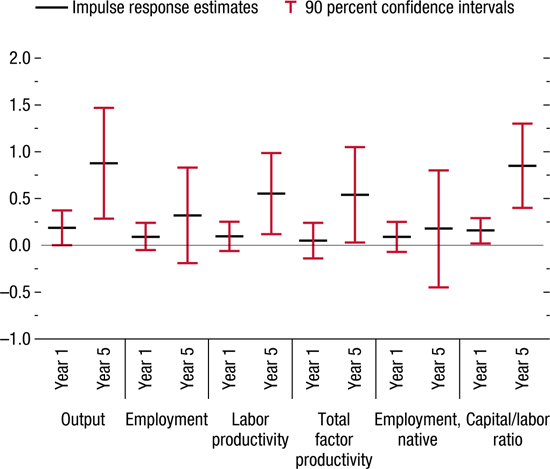
Macroeconomic Effects of Migrants Inflows in Advanced Countries
Source: International Monetary Fund (IMF)
The last straw to clutch to for those vehemently opposed to illegal immigration is another fairy-tale, told and retold more for their own amusement than to raise a point. To begin with, illegal immigrants, just as everyone else, pay sales and income taxes.9 (instead of a Social Security Number, they use ITIN, Individual Taxpayer Identification Number. Did you ever doubt Uncle Sam’s resolve to collect taxes?) In fact, they pay more into Social Security than they will ever be able to take out.10 So, they should be just as entitled as other taxpaying citizens to receive Welfare. However, here’s the often-shunned truth. With some exceptions regarding children and risk to life and safety, undocumented immigrants are barred from receiving most government welfare programs including SNAP and Medicaid.11 Other programs such as ACA and CHIP also exclude those without proper legal documentation.12 Not only is this argument being made on shaky grounds (or rather no grounds at all), but such a focus on welfare has completely eroded the landscape of a rational dialogue concerning undocumented immigrants and their wellbeing. The Right asks, often with an air of haughtiness, “Who is going to house them?” and the Left attempts to raise moral questions, making the case for providing more social welfare programs for undocumented immigrants. What both sides are missing, in my opinion, is that these immigrants, by and large, do not need the help of either the Left or the Right. Who is going to house them? They themselves will house them, as they have been doing for a long time. Who takes care of their children? They are more than capable of doing that too. Figures are hard to come by but over ten million undocumented immigrants currently reside in the U.S. The U.S. homeless population is about 600,000.13 The majority of homeless people are U.S. born citizens. Unless they have been secretly sleeping in your beds, illegal immigrants have been able to find housing and food for themselves amid all difficulties thrown at them by our government.
To be sure, I’m not making a case here for open borders with no security measures. However, I believe those who propose “solutions” for our border “crisis” often gloss over defining what the problem is and how it came about. Immigrants, legal or illegal, have been entering this nation for over 200 years now. Many received citizenship or legal status shortly after entry. Estimates suggest that the U.S. population would have been under 100 million people today had there been no immigration since its founding. But the massive influx of people from all corners of the planet has only dramatically increased economic growth and raised standards of living. For so many years, America has been one of the leading nations in innovation and technology and developments in science and medicine. This is the country that put the first man on the moon, created the first transistor, invented the internet and the first airplane. Lightbulbs and telephones as well as smart phones were introduced from this patch of land in the West to the rest of the world. Around 40% of all Nobel prizes have been won by Americans, over one-third of whom are first-generation immigrants.14 Having the best universities and institutions of higher education, America attracts more foreign students than any other country.15 Our educational entities have published the greatest number of scientific papers in history and our R&D (Research and Development) spending has no rivals in the world.16 America has managed to be the wealthiest nation in the world with one of the highest GDP per capita,17 with real median income rising significantly over time,18 all the while average working hours have fallen by over 40% since the mid-nineteenth century,19 indicating specialization and a massive expansion of industry in both services and goods. With life expectancy having increased roughly twofold since 1850s,20 Americans also live longer than their not-so-distant ancestors.

The United States GDP per Capita
Source: Maddison Project Database
The question then becomes, given that no other country with tight immigration policies has ever even remotely been a match for America’s fast economic progress and, with it, high standards of living, what is the fear of the current wave of immigrants, be they “legal” or “illegal”? The immigrants throughout this country’s relatively short history have housed themselves, entered the labor market, created jobs, added diverse cultural values, helped propel the wheels of this nation forward, and (I can’t help but add this point) introduced great varieties of food to our palate. I suspect this dull hysteria surrounding our southern border will remain a feature of our politics in 2024, then two years after that, then two years after that, and so on with each side claiming to have landed on a solution, without ever bothering to enlighten anyone on what it is that is different this time about their approach. I, on the other hand, am hopeful that immigrants will continue to make this country their final destination and with their presence bring untapped talent, courage, and new recipes.
- Comparing Crime Rates Between Undocumented Immigrants, Legal Immigrants, and Native-born US Citizens in Texas | Office of Justice Programs (ojp.gov) ↩︎
- See no. 1 ↩︎
- Border patrol program budget U.S. 1990-2024 | Statista ↩︎
- Opioids, Cocaine, Cannabis, and Other Illicit Drugs – Our World in Data ↩︎
- Immigration and the Wage Distribution in the United States – PMC (nih.gov) ↩︎
- The Macroeconomic Effects of Large Immigration Waves (imf.org) ↩︎
- Se no. 6 ↩︎
- “Median Earnings by Sex, Education and Generational Status” (census.gov) ↩︎
- Immigrants pay taxes and housing costs, regardless of status | AP News ↩︎
- See no. 9 ↩︎
- Overview of Immigrant Eligibility for Federal Programs – National Immigration Law Center (nilc.org) ↩︎
- See no. 11 ↩︎
- Homelessness in the U.S. hit a record high last year : NPR ↩︎
- List of American Nobel laureates – Wikipedia ↩︎
- Project Atlas_Infographic_2023_2 (iie.org) ↩︎
- List of sovereign states by research and development spending – Wikipedia ↩︎
- Economic Growth – Our World in Data ↩︎
- Median income (after tax), 1963 to 2021 (ourworldindata.org) ↩︎
- Working Hours – Our World in Data ↩︎
- Life Expectancy – Our World in Data ↩︎

 Drunk On Reason
Leave a reply to ottozonian Cancel reply