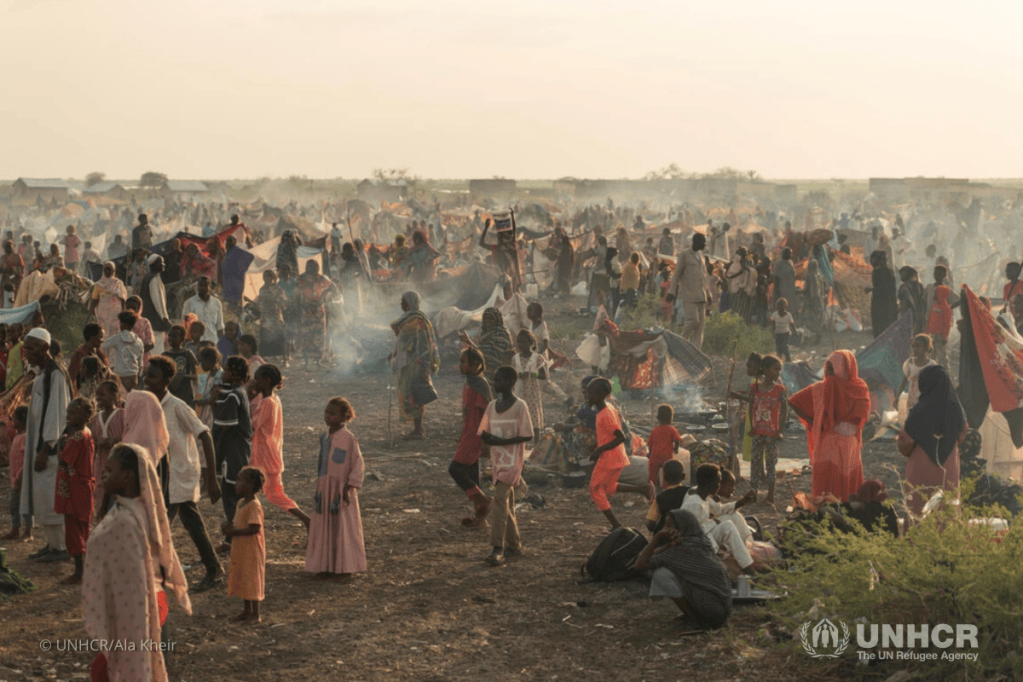
It might be difficult to picture it now, in our 21st century civilization, with all its blessings and advancements and with the rather paradoxical notion of war being “outlawed” but war has been a consistent feature of our species’ collective culture. In fact, it far predates our own species. Animal warfare is pervasive throughout nature untouched by humans where groups of individual animals band together to hunt and invade territories of other animals or hostile members of their own species. Ants, mongooses, hornets, lions and, our closest cousins, chimpanzees and gorillas are just a few examples of many1. While their wars are fought without the use of weapons of mass destruction, nuclear bombs, or drones, one can only imagine that these or possibly more sophisticated weapons would have been used in animal warfare were they able to invent such murder machines. Despite the desperate claims of some sociology and anthropology scholars, the evidence for the desire to conquer and rule over more resources by the use of violence, whether such resources are potential mates or food, are strong and ubiquitous and run deep in our psyche. That we have managed to curb this desire in homo sapiens on an international level is not only a very recent novelty but in fact an aberration of the norm. Ancient societies of all cultures were grappling with war, sometimes multiple times throughout one generation. The evidence from both modern and ancient hunter-gatherer societies clearly shows significantly higher rates of violence compared to even the most violent cities in America (in direct contrast to rosy pictures of such societies painted by rogue scholars and their followers as “peaceful” and “tranquil”). This post is not about why such a desire for violence (much higher for males than females) exists. The answer to that question is quite obvious and backed up by a great deal of scientific literature.2 My post is about whether, on rational and ethical grounds, there is ever a war that is justified and if so, then what are the implications of such a position.
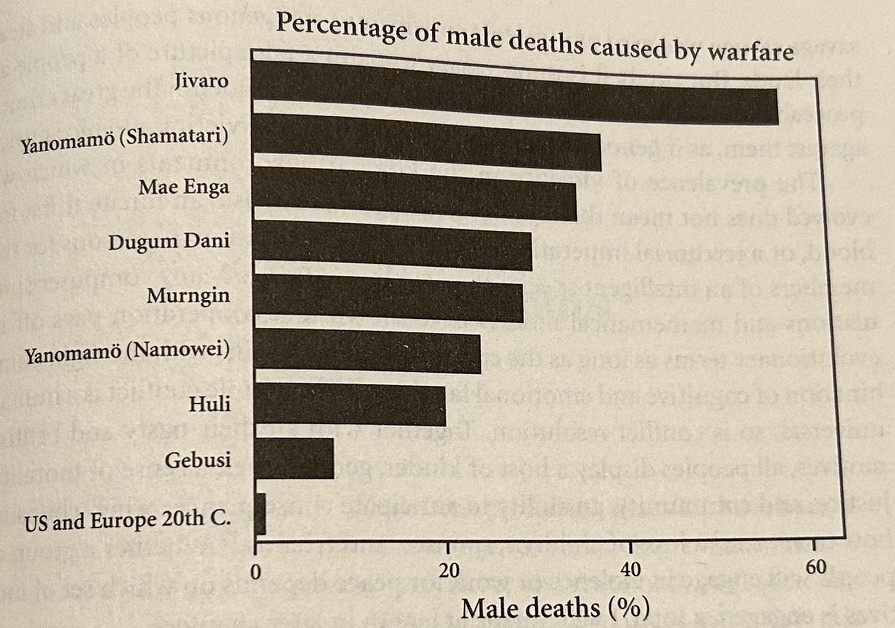
Keely, 1996, graph adopted by Ed Hagen from fig. 6.2 on p. 90.
Firstly, I would like to make the case for my theoretical framework surrounding this issue. Offensive war is at times, albeit very rarely, justified. Afterall, the world does have its fair share of Nazis, Jihadis, Fascists, or other bloodthirsty tribalists whose values are predicated on notions of hate. They justify such notions through half-baked arguments mixed in with pseudoscience and, almost always, sprinkled or entirely dressed with theological rationalizations. Occasionally, such groups manage to mobilize a significant portion of society behind their agendas and gain power. Power that they then consolidate to purge any dissidents and begin their rein of terror upon innocent and guilty souls alike. And at times, with a certain level of overconfidence coupled with some degree of military strength, they attempt to export their tyranny to the neighboring nations (and beyond if possible). Such episodes have frequently played out in human history, often with both (or multiple) sides of a conflict having the same ideological grounding but with different flavors (e.g., my religion good, yours bad! My race good, yours bad! My tribe good, yours bad! You get the idea). However, over the past three hundred years, and especially in the 20th century, ideas of freedom, political representation, democracy, scientific inquiry, and reasoning have slowly made their way into our collective global psyche to the point that even modern despots and dictators have to hide their grievous acts and deny all allegations of abuse in order to have any standing in the world. But when these despots decide to engulf ever more people in misery and become unresponsive to all appeals of restraint or reasoning, and when they become willing to impoverish their nations for the “greater good,” the rest of us need to put a stop to it by force. This is, in my opinion, no different than that stopping a mass shooter with a bullet.
The Pacifist ideology which purports that violence is never justified simply relies on the assumption that everyone is at their core a “noble savage” and that if we “turn the other cheek” enough, the smacking will stop, entirely ignoring the fact that some people enjoy smacking your face and others will do it for as long as it is beneficial to them. I will not delve deep into it but this is demonstrably wrong on both a scientific and historic level. A large body of evidence suggests that humans are, by and large, self-interested and have certain natural desires honed in by evolution over millions of years3. These desires are in conflict with some of our modern moral values and ethical rules. While many of us try to restrain such desires, some of us fail to do so. Most people in the latter category will lack the influence or charisma to leave any tangible impact behind but at times a few, the likes of Hitler, Stalin, and Mao manage to galvanize others by tapping into our most primitive instincts to join their “just cause.” Once they gain enough power, they see no reason to compromise or listen. That is when the question is asked. How would you then reason with those who have abandoned reasoning? What evidence will convince those who have no respect for evidence? In my opinion, when the well-being and livelihood of a large number of people is at stake, an intervention is justified. When and how are questions we can and must ask in every situation. For now, the point is that there is a time and a way to intervene. The Nazis needed to be stopped and, maybe, so does Putin.
However grounded the theory, what happens in the real world is often more complex. Many a “just” war started only to result in more suffering and death than perhaps otherwise would have been. Afterall, reality does not concern itself with our motivations, only the physical consequences of our actions. The first and ovbious issue is the civilian casulaty, the innocent bystanders who largely have no say in the conflict but bear the cost of it. Not to mention the financial cost of war that could be spent in other productive ways alongside the destruction of a nation’s infrastructure and severe disruption of the livelihood of the survivors. Of course there have been exceptions to this but the fact is that there will always be civilian casualties and other costs and this fact must be taken into account while assessing intervention. I would like to emphasize that I am not suggesting that any number of civilian casualties is unacceptable. While every attempt should be made to minimize civilian casualty, it is a cost of any warfare. The question should be whether more suffering and death is caused by a lack of intervention. What history shows is that even in genuinely morally justified wars, so much misery was inflicted for so little gain. If the American goal was to end the suffering of Iraqis, Vietnamese, and Afghanis, then it has, more or less, been unsuccessful in swift and decisive victories to bring about a path to peace and prosperity for these nations. There have been success stories as well of course like that of both World Wars. However, we need to be careful to draw broad lessons from the sporadic and occasional successes while ignoring the more plentiful failures. This is of course true of other countries as well. Furthermore, the idea of a morally justified war is a very recent human invention. Almost all wars prior to the 20th century were fought over land, resources, religion, honor, and other motives that appeal to our thoughtless baseness. So, we have very little data to conclude that a truly justified war, while played out in the real world and not just in our heads, is actually effective. If anything, the evidence seems to point to the contrary.
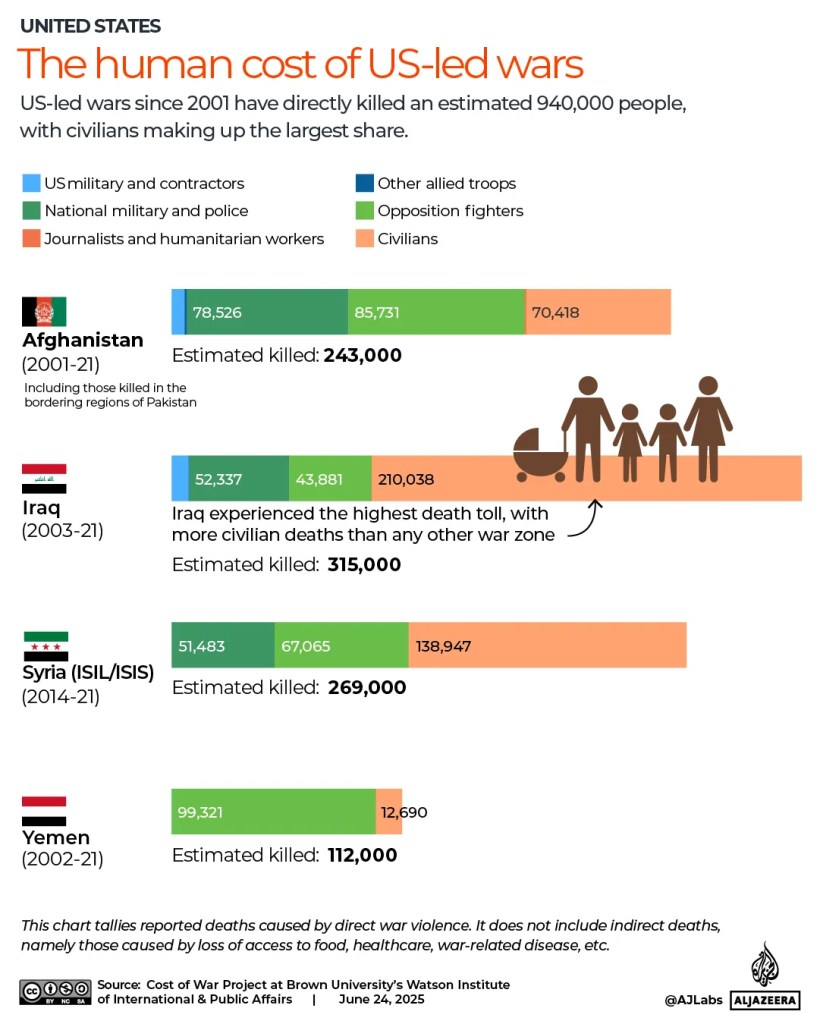
This large cost to human well-being during a war is an important consideration for any decision maker to ponder upon. Unfortunately humans are fallible and those in power are not only not an exception, but perhaps might be even more biased in their judgments than any other average person. This is because statesmen tend to surround themselves with likeminded people who rarely, if ever, are the voice of dissent which could lead to groupthink and irrational decisions based on patchy and inclusive evidence. In our current form of government with powers delegated to the President by a Congress that has effectively abnegated its right to declare war, the decision to launch a preemptive, offensive strike lies in the hands of only a few people. Often there are a handful of influential advisors to the President who can sway his mind in one direction or another and one sufficiently assertive bad actor or simply a misguided person is at times enough for the missiles to begin launching. This is not something that the theory I laid out earlier anticipates but that is how reality is. While there might be a time and a place for military intervention, those with powers invested in them to make such decisions are prone to abusing them to follow their own self-interests or at the very least start seeing Hitlers and Stalins where none exists.
Still, there is a further problem with launching an offensive war. Even if the cause is just, the decision-makers are acting rationally, and the entire cost of war has been well calculated to suggest a significant net positive impact, the ensuing animosity between the parties involved could sow the seeds of future conflicts. After all, the evidence for this from recent history abounds. Serbia and Croatia, South Korea and North Korea, England and Argentina, India and Pakistan, United States and Iran, Israel and Palestine, Rwanda and Congo, Armenia and Azerbaijan, Serbia and Kosovo, United States and Afghanistan, Sudan and South Sudan, etc. The list goes on. Whether any of these conflicts were justified or not, the fact is that the hostility is real and tangible. People, when faced with adversity, do not much care about “justifications” or “rationality.” They care about survival and tribalism. If they believe (rightly or wrongly) that some harm was done to them by others, they will harbor resentment towards those others. This resentment may not stay dormant forever and it might help light the fuel of the next conflict or at the very least keep the tensions high. This is another consideration for anyone who wishes to march on towards another war because “it must be done.”
It is hard to reconcile what works in theory with how messy reality can become. If you are someone who has worked on any projects, whether in school or at work, you can testify to the statement that it is simply an oddity if any one project goes according to plan and on schedule with little to no deviations. This is even though school and work projects tend to be much more contained in terms of their scope and impact all the while having far fewer variables that could change. Just imagine the scope and impact of any war among nations as well as the endless number of variables involved. It is quite arrogant and unrealistic for anyone to suggest that they have fully analyzed a given geopolitical situation and have come up with a solid war plan. In my view, the following is the only way we might start an offensive war. Firstly, the cost-benefit analysis must tilt very significantly towards the benefit side, and not just marginally. Secondly, the decision must be made by Congress, or wherever we have a large number of representatives, not just a few sitting in a war room. Thirdly, the potential aftermath analysis must be done and added to the cost of war. And lastly, the war must be limited to only despotic nations who are either currently waging a war against another country or are causing grave harm to their own citizens. Even after all of this, caution must be taken and alternatives must be exhausted first. But this is becoming too idealistic. I actually do not have much hope for such an analysis by our politicians. To be honest, I’m not even sure if such a thorough analysis is even possible for most cases. It makes me feel uneasy to end this post without any concrete resolution from my side but perhaps it is fitting for the topic at hand. If war and its consequences are messy, and if the decision to go to war is still messier, then I think I can afford a little messy conclusion for this blog post.


Leave a Reply